

PFTWORLD as a Global Leading Aerospace CNC Machining Parts Manufacturer: Base Plates and Drone Precision Parts
Spacecraft Base Plates and Brackets Define a Concrete Aerospace Machining Use
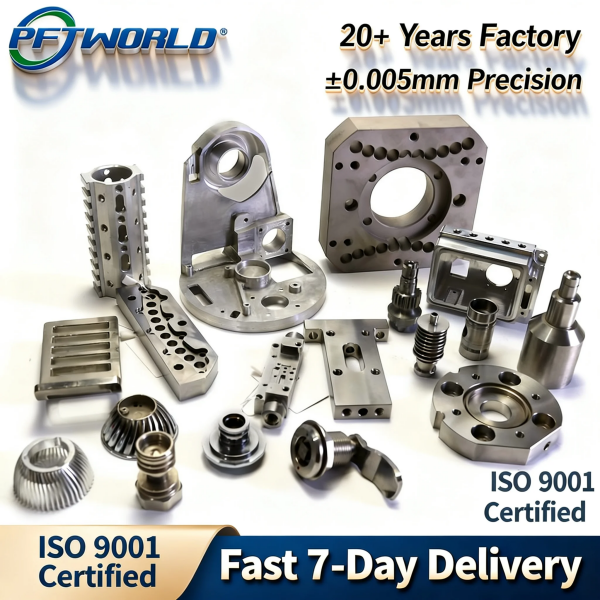
PFTWORLD’s aerospace CNC scope includes spacecraft base plates and brackets planned from defined mounting faces, hole patterns, and positional requirements. For procurement teams evaluating suppliers for space-bound payloads, these components present a clear manufacturing baseline requiring exact adherence to specifications. Base plates and brackets concentrate critical mounting interfaces and datum relationships manufactured precisely from released drawings and checked against a strict geometric dimensioning and tolerancing (GD&T) scheme.
Unlike generic commercial parts, these structural components often require multi-axis machining to reach awkward angles without unclamping. Reducing setups minimizes tolerance stacking, which is critical when a base plate must align perfectly with sensors or payload modules. PFTWORLD’s aerospace component scope supports base-plate and bracket manufacturing by focusing entirely on drawing conformity and dimensional accuracy, rather than attaching parts to unspecified spacecraft programs or customer qualification.
By focusing on physical machining reality—like milling deep pockets for weight reduction while maintaining absolute structural rigidity—buyers gain a reliable measure of supplier capability. Machining involves careful tool path planning to prevent material distortion. Spacecraft base plates and brackets provide a verifiable aerospace application anchor while keeping performance claims inside the documented scope.
Drone Precision Parts Add a Second Aerospace Geometry and Weight-Sensitive Context
PFTWORLD identifies precision drone parts within its aerospace CNC range, allowing procurement discussion to cover unmanned-aircraft components without conflating them with large spacecraft structures. Drone precision parts introduce completely different machining challenges compared to heavier aerospace components. They require highly compact geometry, specialized mounting interfaces for electronics, and low-mass material choices complicating standard milling operations.
Because drone components frequently feature extremely thin walls and intricate internal pockets to shed weight, machining access and dimensional control become highly relevant to component integration. During production, improper tool paths, vibration, or excessive cutting forces can warp thin sections, causing the part to fail final inspection or perform poorly.
To address these risks, drone-part manufacturing remains focused on geometry, materials, and tight dimensional control without extending the scope into airworthiness approval. This pragmatic approach lets engineering teams evaluate supplier ability to handle delicate, tight-tolerance work based on actual production methodology rather than marketing. Drone parts extend the aerospace application range while preserving a distinction between machining capability and end-system qualification.
Aerospace Material Selection Covers Aluminum, Titanium, Nickel Alloys and Stainless Steel
PFTWORLD’s aeronautical machining category supports a specialized material set including 6061 and 7075 aluminum, Ti-6Al-4V titanium, Inconel 718 and 625, and stainless grades like 17-4PH and 316. These materials give engineering teams pathways for balancing mass, strength, corrosion exposure, and temperature requirements across aerospace applications.
Selecting an aerospace-grade material changes the machining environment entirely. For instance, Ti-6Al-4V titanium offers excellent strength-to-weight ratio but generates significant heat at the cutting zone, requiring optimized tool paths, rigid machine setups, and high-pressure coolant to prevent work hardening. Inconel alloys present greater challenges due to extreme toughness and tendency to rapidly wear cutting tools, necessitating specialized carbide inserts and slow feed rates. The exact grade chosen must remain tied to the released drawing and specification to ensure the correct manufacturing approach.
Once material is locked, multi-axis CNC capability can be selected according to feature access, rather than treating aerospace alloy presence as automatic justification for one machine configuration. By aligning material properties with the right cutting strategy, factories maintain surface finish and dimensional stability. The aerospace material range is broad for different component requirements, but machining claims should remain attached to specified grade and geometry.
MTR, CoC and Batch Traceability Connect Aerospace Parts to Their Material Records
PFTWORLD supports controlled aerospace procurement with material records preserving the connection between specified stock and manufactured batch. In aerospace manufacturing, a perfectly machined component is effectively useless if its material origin cannot be proven.
For controlled aerospace parts, Material Test Reports (MTR) or Certificates of Conformance (CoC) can be supplied, and batch traceability maintained. This documentation allows purchasing teams to reconcile material chemistry, mechanical properties, and heat lot numbers with the original order. When a base plate or drone bracket reaches the assembly floor, records provide assurance the metal behaves exactly as engineering analysis predicted, mitigating structural failure risk.
These records should be requested in the Request for Quotation (RFQ) phase, keeping documentation scope explicit instead of assuming every commercial CNC part carries the same traceability package. Defining needs early prevents the costly risk of receiving non-compliant parts scrapped due to missing paperwork. Material documentation strengthens aerospace sourcing when reports remain tied to the exact controlled batch being purchased.
FAI and Dimensional Reports Provide Order-Level Inspection Evidence
PFTWORLD’s aerospace quality support includes AS9102 First Article Inspection (FAI), Coordinate Measuring Machine (CMM) reports, hardness tests, and surface-treatment records when orders require verification layers. Verification is the final, non-negotiable barrier protecting the buyer's assembly line from non-conforming components.
An AS9102 FAI can establish the initial manufactured part conforms to specified drawings before full production continues, rigorously documenting every design characteristic, dimension, and tolerance. Meanwhile, CMM records document complex dimensional features like compound angles, precise bore diameters, or intricate hole patterns requiring measured confirmation beyond manual hand tools.
Hardness or surface-treatment records—like verifying anodized layer thickness or final temper of a heat-treated component—address entirely different acceptance risks. Because each aerospace component faces unique operational stresses, buyers should identify mandatory report types instead of requesting generic “inspection reports.” Order-level aerospace inspection is strongest when reports are selected for a defined material, dimensional, or process-control requirement.
Aerospace RFQ Data Converts the Locked Manufacturer Positioning Into a Controlled Project
PFTWORLD closes the Global Leading Aerospace CNC Machining Parts Manufacturer narrative by asking buyers for the 3D model, grade, GD&T, surface treatment, quantity, and inspection documentation determining the manufacturing route. Abstract manufacturing capability becomes useful when applied to a specific, well-documented set of buyer instructions.
Once these critical inputs are provided, base plates, brackets, and drone precision parts can be reviewed against actual geometry and traceability needs. Essential decisions regarding tooling, machine selection, fixture design, and cycle times are finalized, while MTR, FAI, and CMM requirements are confirmed before cutting raw material.
Spacecraft base plates, drone precision parts, aerospace materials, and quality records give procurement teams a component-level basis for evaluating the manufacturing route. Submitting a complete data package moves conversation from general capabilities to concrete project execution, ensuring predictable outcomes. Component-specific RFQ data makes aerospace capability verifiable at the project level; PFTWORLD aerospace manufacturing information is available at https://www.pftworld.com/.
Shenzhen Perfect Precision Products Co., Ltd.
PFTWORLD
email us here
Visit us on social media:
Instagram
Facebook
YouTube
X
Legal Disclaimer:
EIN Presswire provides this news content "as is" without warranty of any kind. We do not accept any responsibility or liability for the accuracy, content, images, videos, licenses, completeness, legality, or reliability of the information contained in this article. If you have any complaints or copyright issues related to this article, kindly contact the author above.
